
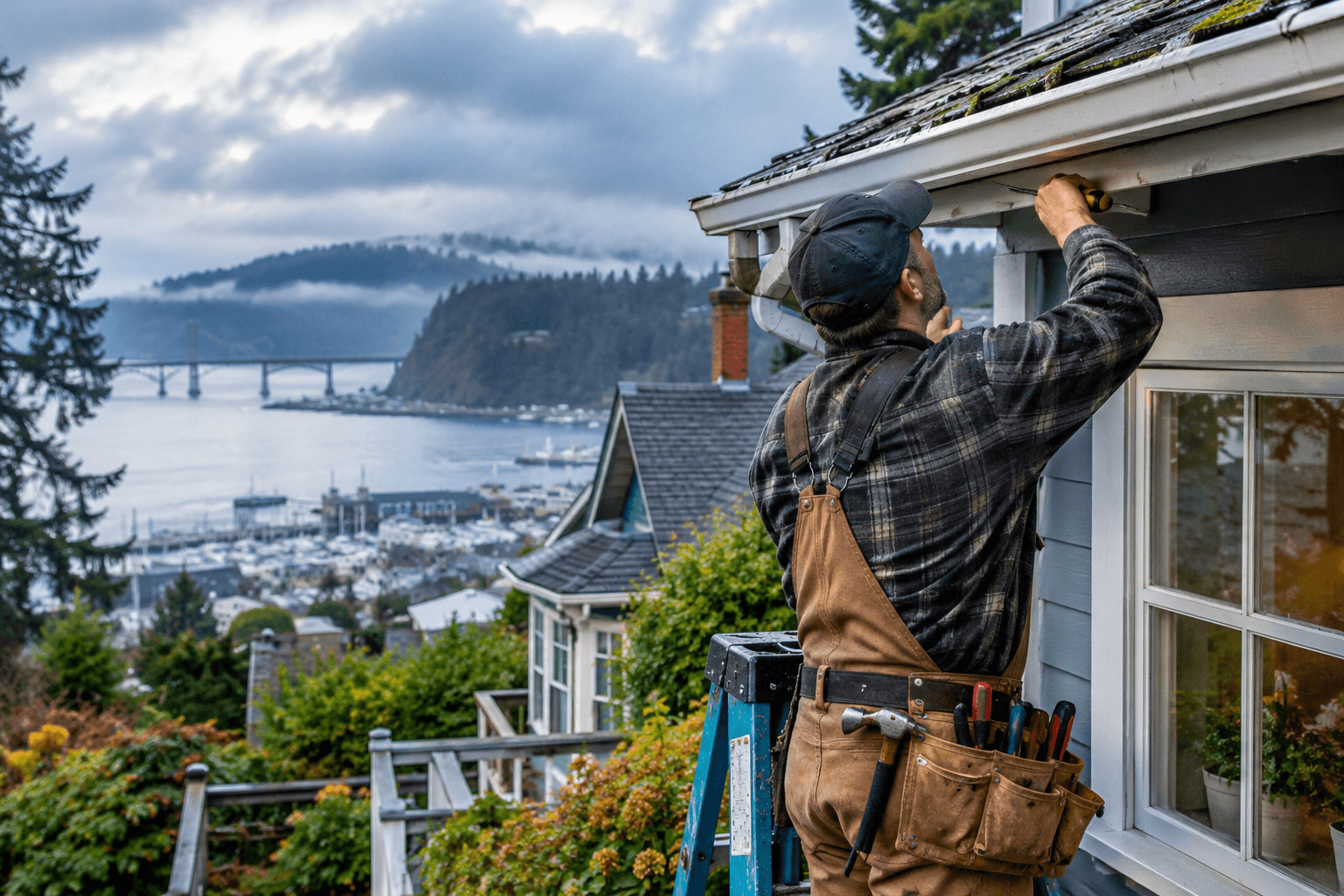
Here’s the honest answer: fix anything that lets water into your house, then fix anything that keeps water from leaving it. Everything else can wait. It’s the last week of September in Eureka, and right now your house is about as dry as it’s going to get until May. We average around 40 inches of rain a year here, almost all of it between October and April, with December alone dumping close to eight inches on us. I’m Matt Jaques, and I’ve been walking around Humboldt County homes every fall since 2008 with a screwdriver in my back pocket and a ladder on the truck. This short dry window is exactly what our handyman services in Eureka are built around.
Why the rush? Because caulk, paint, and wood filler all need dry surfaces to bond, and our dry surfaces have an expiration date. Once the first big storm rolls off the Pacific, every repair turns into a scheduling game with the weather, and every homeowner from Trinidad to Rio Dell is calling at the same time. My crew (Daniel, Christopher, Vincent and I) would much rather knock out your list in October sunshine than in a sideways November drizzle, and your house would rather we did too.
Start With Your Gutters (Yes, Really)
Gutters are the least glamorous part of your house and the most important thing on this list. According to Angi’s guide on how often to clean your gutters, most homes need a cleaning at least twice a year, with spring and early fall as the best times, and homes surrounded by tall trees need it more often than that. Now look out your window. Redwood needles, Sitka spruce, alders dropping leaves on every roof in Cutten. Humboldt homes are the “more often” crowd. Gutter cleaning is one of the most common home repair services we get called for this time of year, and it’s not just scooping gunk. We check the fascia behind the gutter, reseat loose hangers, and make sure the downspouts actually dump water a few feet away from your foundation instead of right against it.
A quick test you can do yourself: after the first real rain, walk outside. Water sheeting over the front edge of the gutter means it’s clogged or sagging. Gutters should run at a gentle slope toward the downspouts, roughly a quarter inch every ten feet. If yours look flat, bowed, or pulled away from the house, that’s a job for us, not a Saturday on a wobbly ladder.
Go Hunting for Rot Before It Hunts You
This is the one that keeps me in business, and I’d honestly rather catch it early. This Old House’s guide to replacing rot-damaged trim puts it simply: rot needs wood, water, and warmth. Eureka supplies the water for half the year and the damp marine layer for the other half, so we’re already two-thirds of the way there before a single storm hits.
The same guide notes that exterior trim is the most vulnerable part of a house, and that it doesn’t have to be old to fail. Their example was trim that rotted just ten years after it went up. That tracks with what I see on Old Town Victorians and Henderson Center bungalows alike. The worst spots are the flat, slow-draining ones: windowsills, the drip caps over windows and doors, and the horizontal trim boards near the ground. End grain soaks up water like a sponge, and joints stay wet long after the rain stops.
Here’s your homework. Grab a screwdriver and gently press it into those spots. Solid wood pushes back. Rotted wood feels spongy, like pressing into a stale muffin. Also look for paint that’s peeling or blistering, and wood that looks darker or greener than the boards around it. If you find soft spots, call us before the rain does the rest of the damage. Small trim repairs in October are a lot cheaper than chasing rot into your framing in March.
Reseal the Gaps
Caulk doesn’t last forever, especially on the coast. Walk your exterior and look at every seam where two different materials meet: window and door trim, corner boards, and anywhere a pipe, wire, or dryer vent pokes through the siding. Cracked, shrunken, or peeling caulk is basically an open invitation for wind-driven rain.
Inside, check your exterior doors. If you can see daylight around the edges or under the door, your weatherstripping and door sweep are done. Replacing them is a quick fix that keeps water out and your heat in, which your PG&E bill will appreciate by January. While we’re resealing, we’ll also flag any painted surfaces where the paint has failed and the wood underneath is exposed. Paint isn’t just about looks here. On the North Coast, it’s armor.
Check the Stuff You Walk On
Decks, porch steps, and railings get slick fast once the rain and algae show up. Before the season turns, look for loose or cupped boards, popped nails, and railings that wobble when you lean on them. A railing that moves an inch in September can fail completely in February when someone grabs it on the way down wet steps. Tightening, re-fastening, and swapping out a few bad boards is exactly the kind of work we do all fall.
What Can Actually Wait Until Spring?
Not everything is urgent, and I’m not going to pretend it is. Interior paint, that cabinet door that doesn’t quite close, the closet shelf you’ve been meaning to add, new light fixtures: none of these care what the weather is doing. If your budget is tight, spend it on the outside of the house now and save the indoor wish list for when the rain lets up. That’s how I’d prioritize my own house, and it’s how I’ll walk you through yours.
A Word on Who You Let on Your Roof
Every rainy season brings a wave of “we were just in the neighborhood” repair offers, and a lot of them are bad news. The National Association of the Remodeling Industry warns that unscrupulous contractors often target homeowners after weather damage, and that many states require contractors to be licensed, bonded, or insured. Its advice holds up: confirm licensing, ask for proof of general liability and workers’ comp coverage rather than taking someone’s word for it, and call at least a few references. We’ve been part of this community since 2008. We’re licensed, we’re insured, and a big share of our work comes from repeat customers and their neighbors. We’re not going anywhere after the storm passes, and that matters when something needs a second look.
Let’s Get Your House Ready
If you’ve read this far, you probably already have a mental list going. Good. Write it down and send it our way. Gutters, rot, caulk, deck boards, that
Here’s the honest answer: fix anything that lets water into your house, then fix anything that keeps water from leaving it. Everything else can wait. It’s the last week of September in Eureka, and right now your house is about as dry as it’s going to get until May. We average around 40 inches of rain a year here, almost all of it between October and April, with December alone dumping close to eight inches on us. I’m Matt Jaques, and I’ve been walking around Humboldt County homes every fall since 2008 with a screwdriver in my back pocket and a ladder on the truck. This short dry window is exactly what our handyman services in Eureka are built around.
Why the rush? Because caulk, paint, and wood filler all need dry surfaces to bond, and our dry surfaces have an expiration date. Once the first big storm rolls off the Pacific, every repair turns into a scheduling game with the weather, and every homeowner from Trinidad to Rio Dell is calling at the same time. My crew (Daniel, Christopher, Vincent and I) would much rather knock out your list in October sunshine than in a sideways November drizzle, and your house would rather we did too.
Start With Your Gutters (Yes, Really)
Gutters are the least glamorous part of your house and the most important thing on this list. According to Angi’s guide on how often to clean your gutters, most homes need a cleaning at least twice a year, with spring and early fall as the best times, and homes surrounded by tall trees need it more often than that. Now look out your window. Redwood needles, Sitka spruce, alders dropping leaves on every roof in Cutten. Humboldt homes are the “more often” crowd. Gutter cleaning is one of the most common home repair services we get called for this time of year, and it’s not just scooping gunk. We check the fascia behind the gutter, reseat loose hangers, and make sure the downspouts actually dump water a few feet away from your foundation instead of right against it.
A quick test you can do yourself: after the first real rain, walk outside. Water sheeting over the front edge of the gutter means it’s clogged or sagging. Gutters should run at a gentle slope toward the downspouts, roughly a quarter inch every ten feet. If yours look flat, bowed, or pulled away from the house, that’s a job for us, not a Saturday on a wobbly ladder.
Go Hunting for Rot Before It Hunts You
This is the one that keeps me in business, and I’d honestly rather catch it early. This Old House’s guide to replacing rot-damaged trim puts it simply: rot needs wood, water, and warmth. Eureka supplies the water for half the year and the damp marine layer for the other half, so we’re already two-thirds of the way there before a single storm hits.
The same guide notes that exterior trim is the most vulnerable part of a house, and that it doesn’t have to be old to fail. Their example was trim that rotted just ten years after it went up. That tracks with what I see on Old Town Victorians and Henderson Center bungalows alike. The worst spots are the flat, slow-draining ones: windowsills, the drip caps over windows and doors, and the horizontal trim boards near the ground. End grain soaks up water like a sponge, and joints stay wet long after the rain stops.
Here’s your homework. Grab a screwdriver and gently press it into those spots. Solid wood pushes back. Rotted wood feels spongy, like pressing into a stale muffin. Also look for paint that’s peeling or blistering, and wood that looks darker or greener than the boards around it. If you find soft spots, call us before the rain does the rest of the damage. Small trim repairs in October are a lot cheaper than chasing rot into your framing in March.
Reseal the Gaps
Caulk doesn’t last forever, especially on the coast. Walk your exterior and look at every seam where two different materials meet: window and door trim, corner boards, and anywhere a pipe, wire, or dryer vent pokes through the siding. Cracked, shrunken, or peeling caulk is basically an open invitation for wind-driven rain.
Inside, check your exterior doors. If you can see daylight around the edges or under the door, your weatherstripping and door sweep are done. Replacing them is a quick fix that keeps water out and your heat in, which your PG&E bill will appreciate by January. While we’re resealing, we’ll also flag any painted surfaces where the paint has failed and the wood underneath is exposed. Paint isn’t just about looks here. On the North Coast, it’s armor.
Check the Stuff You Walk On
Decks, porch steps, and railings get slick fast once the rain and algae show up. Before the season turns, look for loose or cupped boards, popped nails, and railings that wobble when you lean on them. A railing that moves an inch in September can fail completely in February when someone grabs it on the way down wet steps. Tightening, re-fastening, and swapping out a few bad boards is exactly the kind of work we do all fall.
What Can Actually Wait Until Spring?
Not everything is urgent, and I’m not going to pretend it is. Interior paint, that cabinet door that doesn’t quite close, the closet shelf you’ve been meaning to add, new light fixtures: none of these care what the weather is doing. If your budget is tight, spend it on the outside of the house now and save the indoor wish list for when the rain lets up. That’s how I’d prioritize my own house, and it’s how I’ll walk you through yours.
A Word on Who You Let on Your Roof
Every rainy season brings a wave of “we were just in the neighborhood” repair offers, and a lot of them are bad news. The National Association of the Remodeling Industry warns that unscrupulous contractors often target homeowners after weather damage, and that many states require contractors to be licensed, bonded, or insured. Its advice holds up: confirm licensing, ask for proof of general liability and workers’ comp coverage rather than taking someone’s word for it, and call at least a few references.
We’ve been part of this community since 2008. We’re licensed, we’re insured, and a big share of our work comes from repeat customers and their neighbors. We’re not going anywhere after the storm passes, and that matters when something needs a second look.
Let’s Get Your House Ready
If you’ve read this far, you probably already have a mental list going. Good. Write it down and send it our way. Gutters, rot, caulk, deck boards, that mystery drip you noticed last February: we’ll look at the whole house in one visit and tell you straight what needs doing now and what can wait. We serve homeowners across Eureka, Arcata, McKinleyville, Fortuna, Rio Dell, and Trinidad, and our fall calendar fills up fast once the first storm makes the forecast. Take a look at everything our handyman team can take care of, or give us a call at (707) 834-3933. Give us your to-do list. We’ll get it done before the rain does its worst.

Leave A Comment