
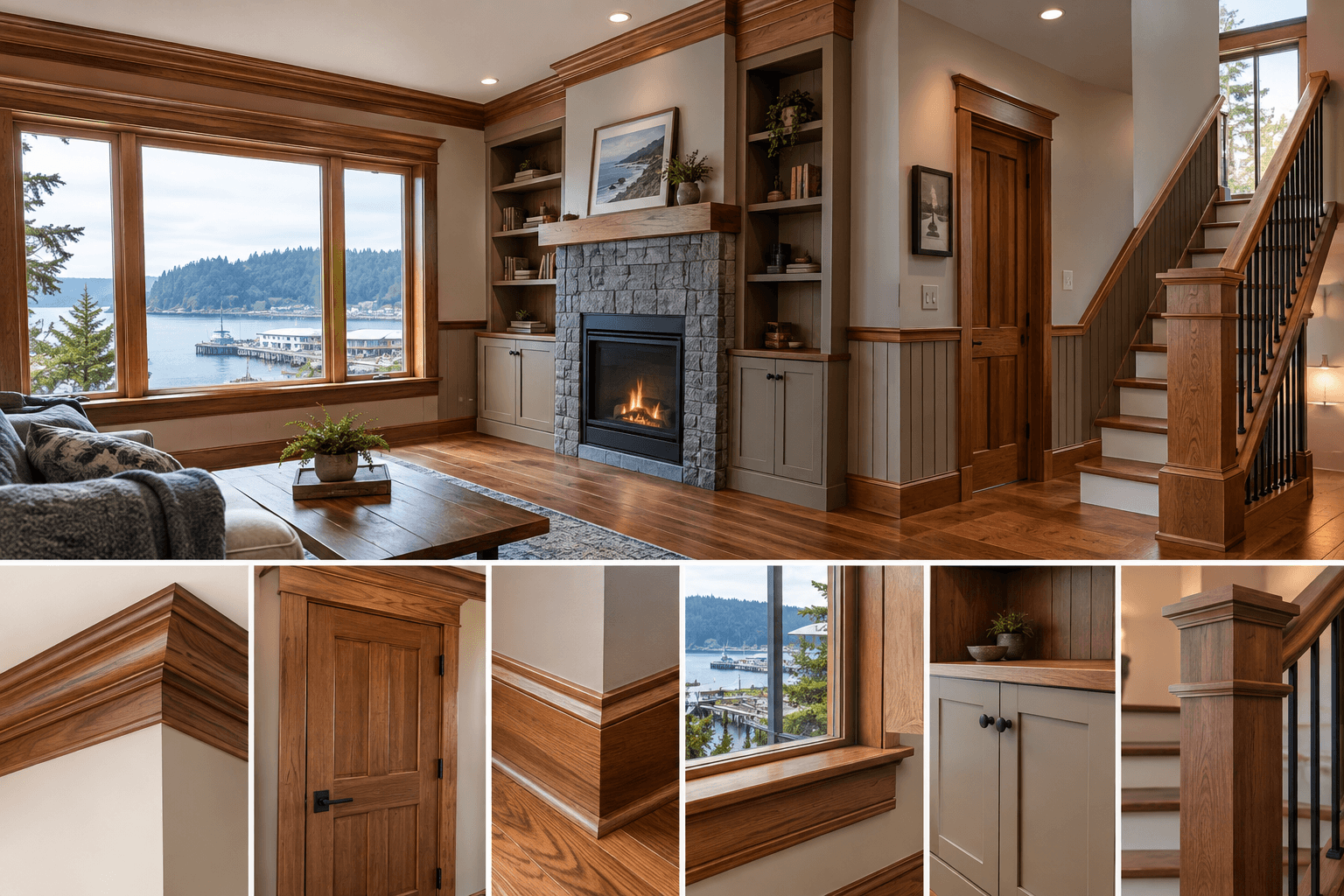
Finish carpentry covers all the detail work that happens after the framing and drywall are done — trim, baseboards, crown molding, door and window casings, built-in cabinetry, shelving, and any woodwork where the seams have to disappear and the corners have to be perfect. It’s the difference between a room that’s “finished” in the sense of having walls and a room that’s finished in the sense of looking like someone actually cared about it. That’s the short answer. Here’s the long one, because there’s more to it than most homeowners realize until they’ve tried to hang a piece of crown molding themselves at 9 p.m. on a Saturday.
I’m Matt Jaques, and I’ve been running finish carpentry services out of Eureka since 2008. My crew — Daniel, Christopher, and Vincent — and I get called out all over Humboldt County, from Old Town to Cutten to the older craftsman homes near Henderson Center, and finish carpentry is consistently one of the most requested and most misunderstood services we offer. People assume it’s “just trim,” and then they find out the hard way that trim is where mediocre work becomes obvious fast.
Here’s the confusion I run into most: rough carpentry and finish carpentry aren’t the same trade, even though both involve wood and a tape measure. Rough carpentry is structural — framing walls, floor joists, roof trusses — none of which anyone sees once the drywall goes up. Finish carpentry is everything visible after that: the baseboards that run the perimeter of every room, the casings around your doors and windows, the crown molding where the wall meets the ceiling, the custom shelving in a closet or built-in around a fireplace, and cabinetry in kitchens, bathrooms, and laundry rooms. If you can see it and touch it, and it’s made of wood or trim material, it’s probably finish carpentry, and it’s exactly the kind of project we handle at Jaques of All Trades.
The reason this distinction matters to homeowners is simple: finish carpentry is unforgiving in a way that rough framing isn’t. A stud that’s an eighth of an inch off gets covered by drywall and nobody ever knows. A baseboard joint that’s an eighth of an inch off is at eye level, catching light, for the next twenty years. Coped inside corners, mitered outside corners, scarf joints on long runs of crown molding in older Humboldt homes with walls that have settled and shifted over sixty or eighty years — this is precision work, and it’s why we treat every finish carpentry job as a chance to show what our team can actually do, not just check a box.
A lot of the calls we get start with someone who tried the DIY route first. They picked up pre-primed MDF trim at the hardware store, watched a few videos, and ran into the same wall everyone does: nothing in an older Eureka home is actually square. Floors have settled, corners aren’t true 90-degree angles, and a miter cut that looks perfect on paper leaves a gap you can see from across the room. That’s usually the point where finish carpentry services from a crew that does this daily starts to look less like an upgrade and more like the thing that should’ve happened first.
So what does a finish carpentry project with us actually look like? It depends on the room, but the categories break down pretty cleanly:
Trim and moldings. Baseboards, crown molding, chair rails, and window and door casings. This is the most common request we get, and it’s also the fastest way to make an older home feel intentional again instead of just “original.” Crown molding especially tends to hide a multitude of sins where ceiling and wall meet unevenly — common in a lot of the pre-1960s housing stock around here.
Custom cabinetry. Kitchens, bathroom vanities, laundry room storage, and built-in units around fireplaces or in home offices. This is where finish carpentry blends into cabinetmaking — measuring for a space that’s rarely perfectly square, building or installing to fit, and making sure doors and drawers actually operate smoothly for years, not just on install day.
Doors and door casings. Interior door installation, replacing warped or swollen doors (a real issue with our coastal humidity), and finishing the casing around them so the whole opening looks like it was built as one piece rather than patched together.
Shelving and built-ins. Closet systems, bookshelves, window seats, and other custom storage that’s built to the actual dimensions of your space instead of squeezed in from a flat-pack box.
One thing I always tell people during the estimate: finish carpentry is one of those services where the material matters almost as much as the labor. Humboldt County’s marine layer and humidity swings are hard on wood that isn’t properly sealed or acclimated before installation — we’ve been called in more than once to fix trim that was installed correctly but with the wrong material for our climate, and within a year it had cupped, gapped, or cracked at the joints. Part of what you’re paying for with an experienced crew isn’t just the cut — it’s knowing which materials hold up in a house four blocks from the bay versus one up in Cutten.
If you’re trying to decide whether your project needs a finish carpenter specifically versus a general handyman, here’s a rule of thumb that’s served our clients well: if the result is going to be at eye level, in a room you use every day, and visible from more than one angle, it’s worth getting it done by someone who does finish work as a specialty rather than a side task. Baseboards in a rarely used utility room are more forgiving. Crown molding in your living room, or a custom built-in flanking your fireplace, is not — and it’s exactly the kind of project where a rushed job or the wrong joint technique becomes a permanent, visible reminder every time you walk into the room.
That’s really the whole philosophy behind how Jaques of All Trades approaches finish carpentry: it’s the last thing anyone touches in a project, which means it’s the thing everyone actually notices. We’d rather take the extra time to get a coped corner right than hand back a “good enough” result that looks fine from six feet away and disappointing up close.
If you’ve got a trim project, a cabinetry upgrade, a door that’s never fit quite right, or a built-in you’ve been picturing for years, reach out to our team and we’ll walk the space with you before quoting anything. And if you’re still not sure whether your project counts as finish carpentry or general handyman work, that’s a fair question to bring to us too — we’ll tell you honestly which category it falls into, even if the honest answer is “you don’t need us for this one.” According to Angi, trim and molding work is consistently one of the highest-ROI interior upgrades a homeowner can make, and This Old House has long treated finish carpentry as its own specialized trade distinct from framing for exactly the precision reasons above. The National Association of the Remodeling Industry (NARI) also recommends vetting finish carpentry contractors specifically for portfolio examples of trim and cabinetry work, not just general remodeling experience — which is a good gut check no matter who you end up hiring.
Give us a call at (707) 834-3933, or drop by 1609 Dean St. here in Eureka. We’d rather talk through the details with you up front than have you find out the hard way what a rushed miter cut looks like in five years.

Leave A Comment