
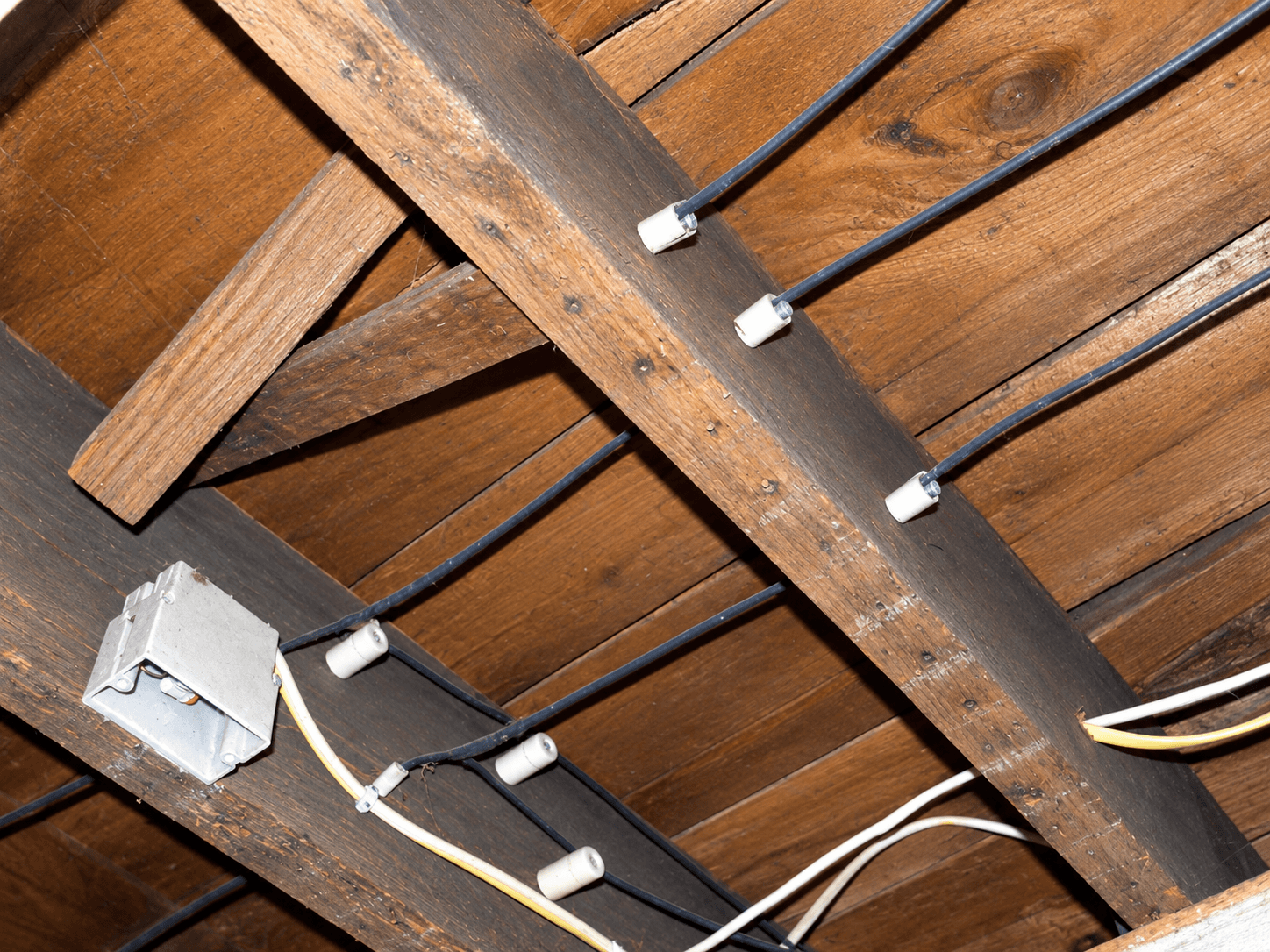
Every October, right about when the first real rain blows in off Humboldt Bay, my phone starts ringing with the same kind of call. Somebody climbed into the attic to finally add insulation before winter, and they found little white porcelain knobs nailed to the rafters with cloth-covered wires strung between them. They want to know whether to panic. At Jaques of All Trades, we’ve been answering that question for Eureka homeowners since 2008, and the honest answer is: don’t panic, but don’t ignore it either. Getting trained eyes on it is exactly what our electrical services are for.
I’m Matt Jaques, and knob-and-tube is about as Eureka as it gets. Roughly three in ten homes in this city were built before 1940, which means a lot of us are living with century-old wiring whether we know it or not. My crew and I spend a good chunk of every fall in Old Town Victorians and Henderson Center bungalows sorting out what’s still sound, what’s been hacked together over the decades, and what needs a licensed electrician’s full attention. Here are the five questions I hear most, answered straight.
How Do I Know If My House Has Knob-and-Tube Wiring?
Knob-and-tube was the standard way to wire a house in North America from about 1880 into the 1940s. Head into the attic, basement, or crawlspace and look for single wires running separately from each other, held off the framing by ceramic knobs and threaded through ceramic tubes where they pass through joists.
Inside the house, the giveaways are two-prong outlets, push-button light switches, and an old screw-in fuse box. Knob-and-tube systems have no ground wire, so a house full of two-slot outlets is a strong hint.
One catch: not seeing it doesn’t mean it’s gone. Plenty of homes got “updated” with new outlets and a new panel while the original runs stayed live inside the walls. A voltage tester and some experience tell you a lot more than a flashlight does.
Is Knob-and-Tube Wiring Actually Dangerous?
Here’s the part that surprises people: original, untouched knob-and-tube was often installed well. The wires were spaced apart so heat could escape into open air, and the workmanship was usually solid.
The trouble is everything that happened in the hundred years since. According to InterNACHI’s guide to knob-and-tube wiring, unsafe modifications are far more common with this system than with modern wiring, and amateur splices into newer cable are a classic problem. The old rubber-and-cloth insulation also turns brittle with age, and when it cracks, you’ve got bare copper sitting next to old-growth redwood framing.
That matters because wiring is a serious fire source. National Fire Protection Association research found that electrical distribution and lighting equipment causes about 32,620 home fires a year, with roughly 430 deaths, and wiring accounts for the largest share. Those fires peak in the winter months, which is a long way of saying that right before space-heater season is a smart time to take a look.
Can I Insulate My Attic If I Have Knob-and-Tube Wiring?
This is the big fall question, and it’s where well-meaning DIY projects go sideways. The National Electrical Code (Article 394.12) prohibits concealed knob-and-tube in hollow walls, ceilings, and attics where insulation envelops the wires. Those conductors were designed to shed heat into open air, and burying them traps it.
California is one of the few places with a workaround. The California Electrical Code allows insulation around knob-and-tube only when specific conditions are met: a California-licensed electrical contractor surveys the wiring and certifies it’s in good condition, the insulation is noncombustible and contains no conductive material, and warning notices are posted at the attic access. Local building departments can also require permits and inspections.
So if there’s a pile of insulation waiting in your garage, hold off. Before anything goes in, we’ll walk the attic, flag damaged runs and sketchy splices, and line up the licensed electrical contractor who can either sign the certification or tell you the wiring needs to go. That’s the kind of older-home electrical work we coordinate every fall so nobody ends up with a failed inspection or a voided insurance policy.
Often, yes. Many insurance companies refuse to cover homes with knob-and-tube wiring because of the fire risk. Others will write the policy but want an electrician’s inspection report, charge a higher premium, or require replacement within a set window.
It also shows up when you sell. Home inspectors flag it, and buyers, lenders, and insurers all react to that line in the report. In a market full of pre-war homes like ours, having a documented evaluation in hand can keep a sale from stalling in escrow.
My advice: call your agent before you call anyone else. Ask exactly what they require, whether that’s an inspection letter, partial replacement, or a full rewire, and get the answer in writing. Then you’re solving the right problem instead of guessing.
Do I Have to Rewire the Whole House, and What Does It Cost?
Not necessarily, and not necessarily all at once. As Angi’s breakdown of knob-and-tube safety points out, unmodified and unextended knob-and-tube circuits can be safe if they’re left alone. The Electrical Safety Foundation International recommends that any home over 40 years old get an electrical inspection by a licensed electrician, and in Eureka that covers most of the houses I walk into.
When full replacement is the right call, the national average runs about $24,300, with most projects landing between $12,000 and $36,600, according to Bob Vila’s look at knob-and-tube replacement costs. Plaster-and-lath walls, tight crawlspaces, and an outdated fuse panel all push that number up.
Two things I tell every homeowner. First, in California, any job over $1,000 in labor and materials requires a licensed contractor, and a rewire falls under the C-10 electrical classification. A full rewire is not a handyman job, and anyone who tells you otherwise is waving a red flag.
Second, rewiring an old house means opening walls and ceilings. That’s where my crew earns its keep on the back end: we patch plaster and drywall, rehang trim, and put the room back together so it looks like nobody was ever in there. Keeping the electrician and the cleanup coordinated under one roof saves you weeks of chasing two different crews.
In the meantime, a few habits help. Don’t hang anything from those old wires, keep space heaters off aging circuits, and where a rewire isn’t in the budget yet, consider GFCI protection on two-prong outlets. The code requires those outlets to be labeled “No Equipment Ground” so the next person knows what’s behind them.
My Professional Advice
Knob-and-tube wiring isn’t an automatic emergency, but it’s not something to bury in insulation and forget, either. If you’ve found porcelain knobs in the attic, two-prong outlets in the bedrooms, or a fuse box in the basement, the next step is a walkthrough from Jaques of All Trades. We’ll tell you what you’ve got, what’s safe to leave, what needs a licensed electrician, and how to get it all handled before the winter storms settle in. Give us a call at (707) 834-3933 or schedule an electrical walkthrough with our team. Let’s make sure the only thing glowing in your house this winter is the fireplace.

Leave A Comment