
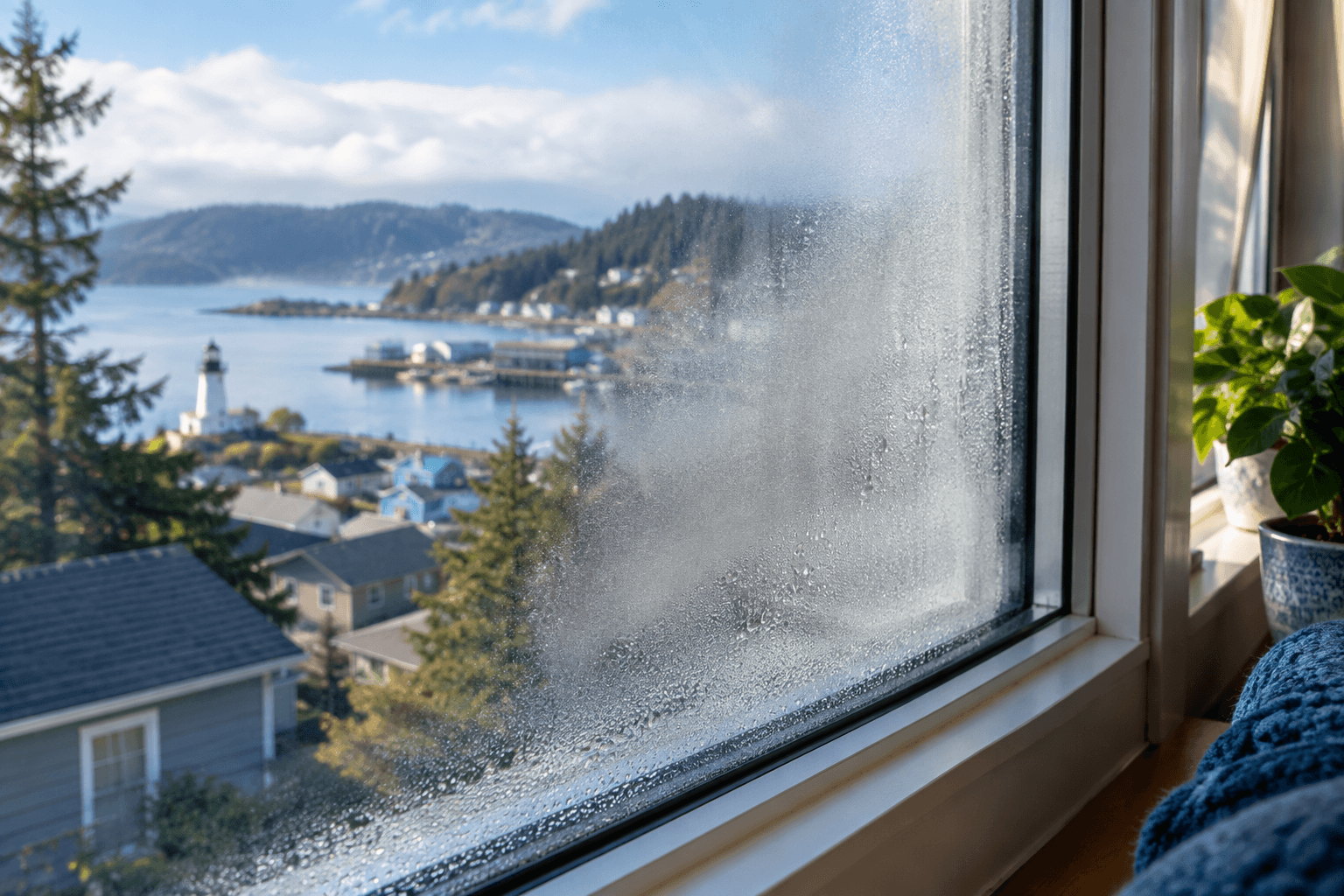
I get this call every year right around the time the fog rolls in thick off the bay and the first real rain finally breaks the dry spell. Somebody’s standing at their kitchen window with a rag in one hand and a bottle of Windex in the other, scrubbing at a haze that just will not come off, getting more frustrated by the minute. I always ask the same question before they even finish describing it: “Are you wiping the inside of the glass, or is the fog trapped in the middle, between the two panes?” Nine times out of ten, it’s the second one, and that’s when I know exactly what we’re dealing with — and exactly how Jaques of All Trades is going to fix it.
Here’s the thing nobody tells homeowners when they buy a house with double-pane windows: that fog isn’t dirt, and it isn’t something a stronger cleaner is going to touch. Modern insulated windows are built as a sealed unit — two panes of glass with a gap of insulating gas trapped between them, held together by an edge seal. When that seal fails, humid air sneaks into the gap and condenses right where you can’t reach it. No amount of scrubbing from either side is going to clear it, because the moisture isn’t on a surface you can touch. This is exactly the kind of job our team handles start to finish, from the diagnosis on your porch to the actual glazing work, which is why I always tell people to get us out for a look at the full picture of what a glass contracting job actually involves before they spend a Saturday morning fighting a problem that isn’t going anywhere.
What’s actually happening inside that sealed unit is more interesting than people expect. That gap between your panes is usually filled with argon gas, which is what makes a modern window insulate as well as it does. Once the edge seal breaks down — usually from years of sun exposure and the glass expanding and contracting through temperature swings — that gas slowly leaks out, whether or not you’ve noticed any fog yet. The visible fog is actually a late-stage symptom. By the time you can see it, your window has usually already lost a real chunk of its insulating performance, which is part of why we treat this as more than a cosmetic fix when we’re out at a job.
Most window seals hold up somewhere between 10 and 20 years before this starts happening, and coastal Humboldt County is not gentle on that timeline. Angi’s data on window seal repair puts foggy-window fixes in the $75 to $200 range on average — worlds apart from what people assume they’re about to pay. Between the marine layer that sits over Eureka for a good chunk of the year and the temperature swing between a warm woodstove-heated living room and a 45-degree, damp night outside, we put more stress on a seal here than a lot of drier inland climates do. I’ve opened up plenty of Old Town Eureka Victorians where the original single-pane glass has long since been swapped for double-pane retrofits, and those retrofit seals are often the first thing to go. This is why fall, right as the rains set in, is when my phone actually starts ringing about this — not because anything new broke, but because the temperature difference finally makes a seal that’s been failing all along impossible to ignore.
I want to save people money here too, because I know a “window problem” sounds like it’s going to cost a small fortune. It doesn’t have to. In almost every case, we don’t need to tear out your whole window and frame — we can replace just the glass unit itself, which is a fraction of the cost and the mess of a full window replacement. This Old House’s own reporting on window seal repair backs up what I tell people every week: replacing the insulated glass unit is usually the more reliable and far cheaper fix than starting over with a whole new window. That’s a conversation I have constantly, because a lot of folks assume foggy glass automatically means a five-figure window project, and it almost never does. It’s exactly the kind of call our glass contracting team fields all the time, and it’s usually a much smaller job than people brace themselves for.
I’ll be straight with you about the DIY route too, because I’d rather you hear it from me than learn it the hard way. Drilling a hole in the glass to “vent” the moisture out is a trick that shows up online constantly, and it might clear the haze for a little while. But it doesn’t replace the argon gas you’ve already lost, and it doesn’t fix the seal — most of the time that fog creeps back within months, and now you’ve also put a hole in your window. It’s a patch, not a repair, and I’ve had more than one client call us back six months after trying it themselves, a little sheepish, ready to just do it right the second time.
Leaving a failed seal alone longer than you need to isn’t just an efficiency problem, either. That trapped moisture doesn’t always stay politely between the panes — over time it can work its way into the sash and frame, and in an older wood-frame window that’s exactly how you end up with soft, rotting wood behind glass that looked fine on the surface. It’s the kind of downstream damage the National Association of the Remodeling Industry trains its members to catch early rather than let compound, and I’ve found that more than once on a job that started as “can you just fix my foggy window.” It’s a much better day for everyone when we catch it before it spreads.
My dad didn’t start this business — I did, back in 2008, and it’s grown into something my crew and I are genuinely proud of, one job and one referral at a time. Daniel, Christopher, and I have walked into more Eureka living rooms than I can count where someone’s embarrassed about a window they’ve been “meaning to deal with” for two years, and honestly, that’s most of our calls. There’s no judgment in it. Between the marine fog, the redwood-coast damp, and the rain that’s about to move back in for the season, this climate finds the weak spot in a house eventually — that’s just Humboldt living. What I care about is that when you finally do call, it’s a straightforward fix, not a surprise.
So if you’ve got a window in your house that’s gone hazy and no amount of glass cleaner is touching it, don’t keep scrubbing — that fog isn’t coming out from the outside, and every month you wait is another month of lost insulation and a slightly higher chance we’re dealing with frame damage instead of just glass. Give Jaques of All Trades a call for a straight-up glass contracting quote, and we’ll come take an honest look, tell you straight whether it’s a glass-only fix or something bigger, and get it handled before the rainy season really settles in. We’ve been doing this in Eureka since 2008, and a clear window that actually keeps the cold and damp where it belongs is about as satisfying a fix as this job gets.

Leave A Comment