
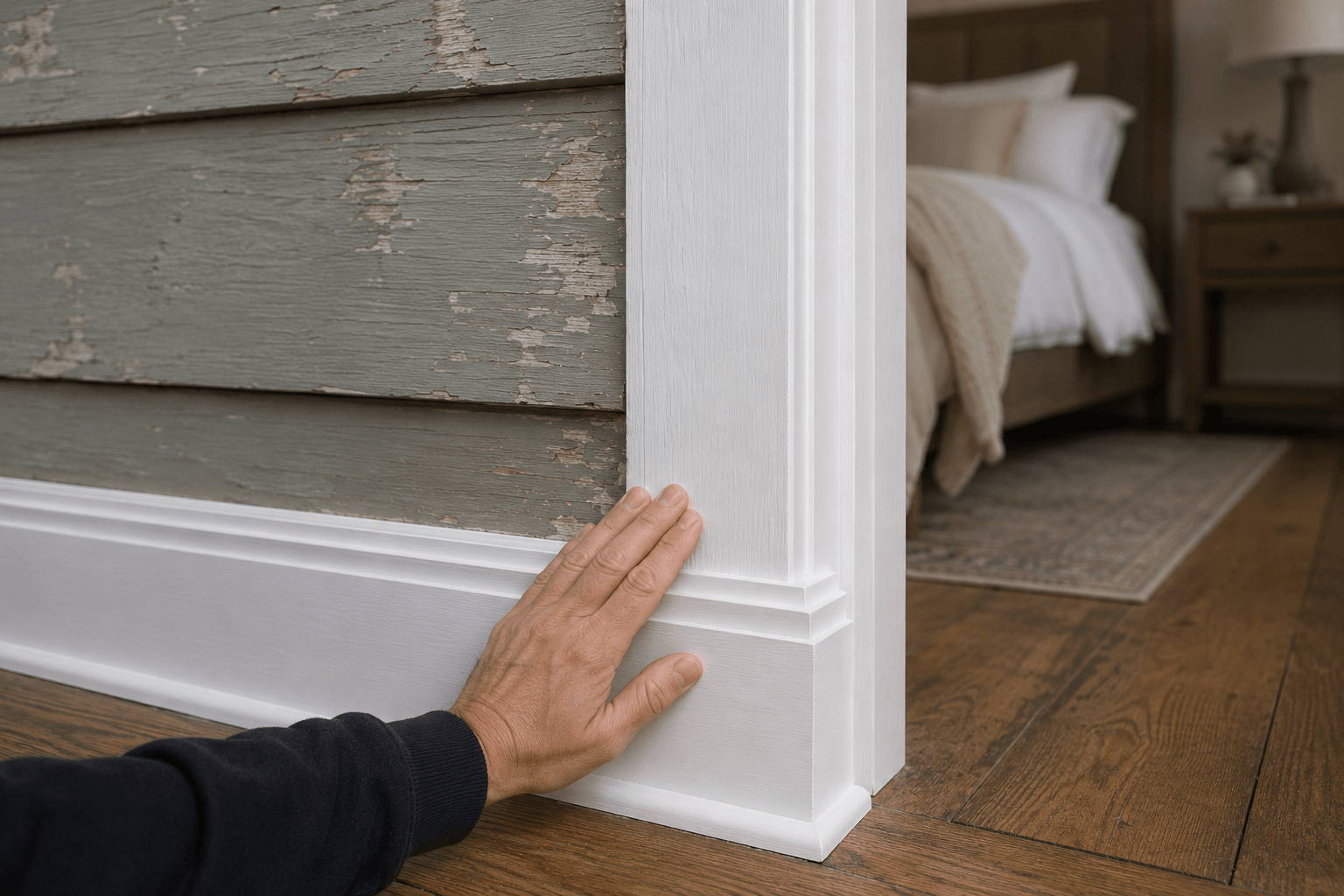
I had a client text me a TikTok video last month. No “hey Matt,” no “quick question” — just a link, and thirty seconds later, a follow-up: “can we do this??”
The video showed a woman transforming a plain bedroom into what looked like a French chateau using nothing but scissors, a roll of foam trim, and the kind of confidence that only comes from never having actually installed trim before. Ninety seconds, zero tools, zero mess. My client’s walls, for reference, were built in 1948 and have settled the way most houses in Eureka settle — which is to say, enthusiastically, and in several directions at once.
I get why peel-and-stick trim is having a moment. It’s cheap, it’s fast, and it promises the one thing every homeowner secretly wants: a finished-carpentry look without hiring a finished carpenter. But here’s the question nobody in those videos is answering, and the one I actually get paid to answer — does it work on a house that isn’t perfectly square? Because spoiler: almost none of them are.
Why Your Walls Aren’t as Straight as You Think
New construction walls are framed, hung, and taped to a standard. They’re about as close to true as a wall gets. That’s the world peel-and-stick trim was designed for — smooth drywall, square corners, a factory-flat surface for the adhesive to grip.
Humboldt County is not that world. Between the redwood-era balloon framing, decades of humidity swelling and shrinking the studs, and the fact that this whole region sits on some of the more seismically active ground in California, our walls move. Floors settle unevenly. Door casings shift a quarter inch over twenty years and nobody notices until they try to install something that assumes they didn’t. I’ve popped open plaster walls in Old Town Eureka that were never flat to begin with — they were flat-ish in 1910, and gravity has had over a century to work on that.
When a wall isn’t straight, a flexible foam strip doesn’t fix that — it just shows it to you in a whole new way. The gaps don’t disappear. They just become foam-colored gaps instead of drywall-colored gaps, usually right at eye level, right where guests are looking for compliments to give you.
What Peel-and-Stick Trim Is Actually Good At
I don’t want to be the guy who trashes a whole product category because it threatens my invoice. Peel-and-stick trim earns its popularity honestly in the right situation. If you’re a renter who can’t nail anything into a wall, if you’re framing a piece of art or wallpaper panel, or if you’re in a genuinely new-construction space with true corners, it can look great, and it costs almost nothing to try. It’s also fully reversible, which matters if you’re the type who redecorates every couple of years.
Where it falls apart is anywhere a wall meets a floor, another wall, or a doorframe at anything other than a textbook angle — which, in an older Eureka home, is most places.
What Real Finish Carpentry Is Solving For
This is the part that never makes it into a ninety-second video: professional trim work isn’t really about the trim. It’s about making an imperfect wall look perfect. Every finish carpenter’s actual skill is in a technique called scribing — tracing the exact contour of a wonky wall or floor onto a piece of solid trim, then cutting it to match that contour so it sits tight with no visible gap. Fine Homebuilding has a good rundown of the process if you want to see how much precision actually goes into a scribed cut — it’s not glamorous work, but it’s the difference between trim that looks built-in and trim that looks stuck on.
Inside corners get the same treatment with a technique called coping, where one piece of trim is cut to hug the exact profile of the piece next to it instead of just mitered at 45 degrees and hoping the wall cooperates. Miters look fine on paper and in showroom corners. In a real house with a wall that’s slightly out of square — which, again, describes almost every wall I’ve worked on in this county — a mitered corner opens up as the seasons change. A coped corner doesn’t, because it was never relying on the angle being perfect in the first place.
None of that is something a $19 strip of adhesive foam can replicate, no matter how good the TikTok lighting is. It’s also exactly what we spend most of our time doing whenever a homeowner brings us in for professional trim and molding work — less time trimming, more time convincing a wall to cooperate.
The Real Cost Comparison Nobody’s Doing
Peel-and-stick trim looks like the budget option until you count the redo. I’ve been called into more than one house where a homeowner tried the DIY route, got frustrated with gaps that wouldn’t stay caulked, and ended up paying to have the foam pulled off and real trim installed anyway — which costs more in total than if they’d just started with our finish carpentry services in the first place. It’s not that different from buying a cheap tool twice instead of a good one once.
That’s not a scare tactic — it’s just what happens when a product designed for flat drywall meets a wall that hasn’t been flat since the Truman administration. If your home is newer or your walls genuinely check out square, the math might work out fine for you. I’d rather tell you honestly which category your house falls into than sell you a “no” on principle.
So, Should You Try It?
Here’s my honest answer, the same one I’d give a friend standing in my driveway with their phone out: grab a level and check a few spots first. Hold it against your baseboard, your door casing, a stretch of bare wall. If it reads true across the board, peel-and-stick trim is a legitimate, low-risk way to dress up a room, and I’ll happily tell you to save your money and do it yourself.
If that level is rocking even slightly, or if your house was built before 1970 anywhere in Humboldt County, do yourself a favor and get an honest opinion before you buy a $90 roll of foam trim for a problem it can’t solve. Angi’s breakdown of what professional trim installation actually costs is a decent starting point if you’re trying to figure out whether the DIY route is really saving you anything — and if you’d rather skip the research and just have someone walk your rooms with a level, that’s what I’m here for.
Either way, I’d rather you make the call with your eyes open than find out the hard way, three tubes of caulk into a Saturday, that your wall had other plans. And if you want a second opinion before you commit to a project — whether it’s peel-and-stick or the real thing — reach out and I’ll take a look. I’ve seen enough Humboldt County walls to know within about ten seconds which category yours falls into.

Leave A Comment