
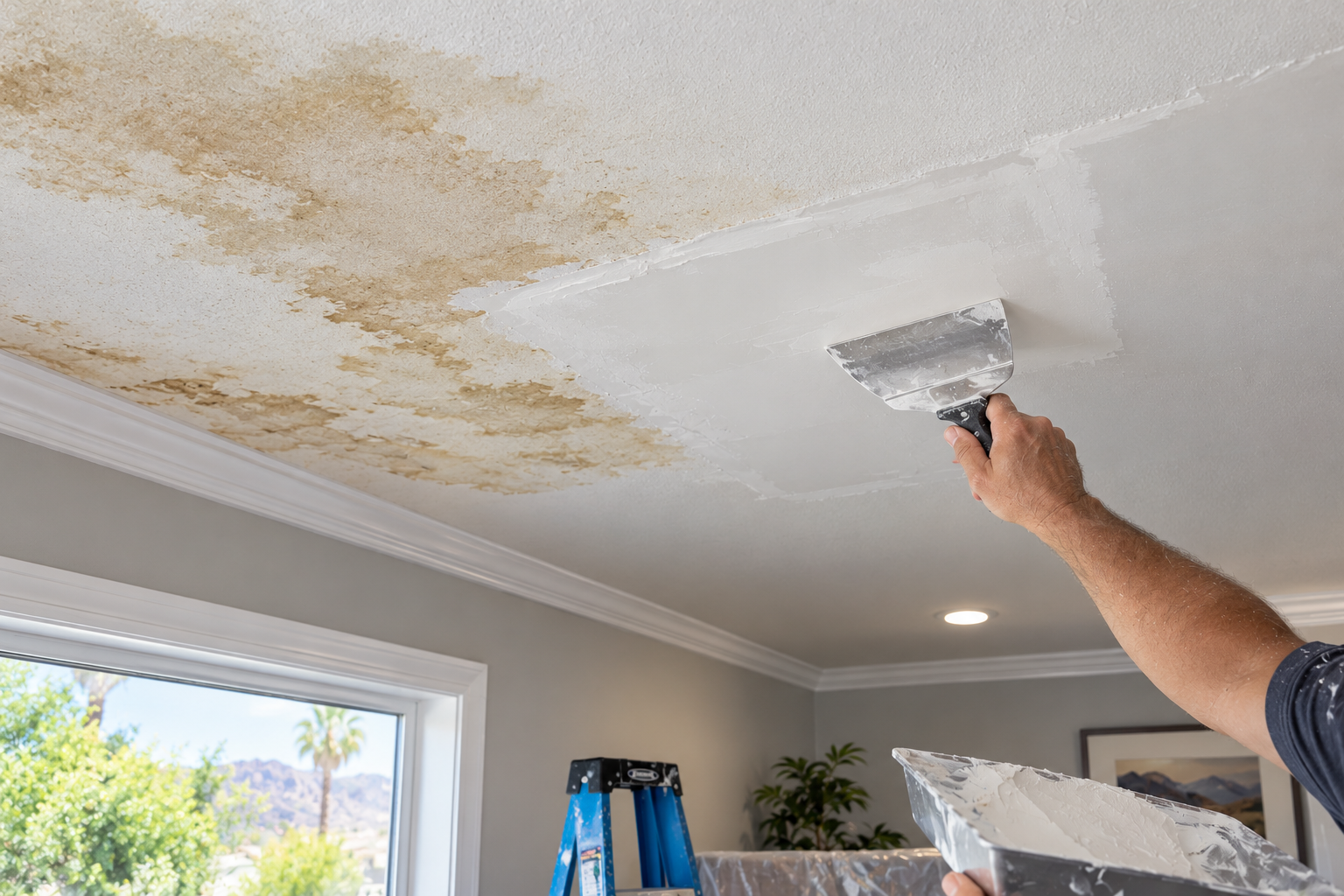
Every October I can predict what my phone is going to do. The first real storm rolls off Humboldt Bay, and by Tuesday I’m getting calls about brown rings on ceilings, bubbling paint under windows, and one wall in the laundry room that “feels kind of soft.” I’m Matt Jaques, and I’ve run Jaques of All Trades here in Eureka since 2008. Most of those callers ask me the same thing: can it be fixed, or does the whole wall have to go? The honest answer is “it depends.” I can tell you what it depends on, so you’ll know what you’re looking at before you call us.
Some context first. Eureka gets roughly 40 inches of rain a year, and almost all of it falls between October and April. Add our marine layer, which keeps humidity high even on dry days, and you have a town that’s hard on gypsum board. Drywall is cheap, quick to install, and easy to finish. But it handles water about as well as a paper towel does. When a roof flashing fails or a supply line under the sink starts weeping, the wall soaks it up. Our crew sees the results every week through our drywall repair services in Eureka.
What happens to drywall when it gets wet?
Drywall is a gypsum core sandwiched between paper facings. A brief splash usually stays on the surface and does no real harm if you dry it fast. Prolonged soaking is different. Once the gypsum core is saturated, it loses its structural integrity. It may look fine once it dries, but it often crumbles when you press on it, and it no longer holds screws. That’s why ceiling drywall sags. The panel gets heavy with water and tears away from its fasteners. Daniel, Christopher, Vincent, and I start every water job the same way: we test the panel’s integrity before we talk about patching.
The bigger problem is what grows behind the wall. According to the EPA’s guide to mold and moisture, wet building materials should be dried within 24 to 48 hours to prevent mold growth. The paper facing on drywall is exactly the kind of food mold likes. The EPA also notes that absorbent materials like drywall may need to be thrown out once they’re moldy, because you can’t fully clean mold out of a porous surface. A leak you find on day one is often a patch job. The same leak found on day ten is usually a replacement job. When we’re called early, we can usually save you money.
When can water-damaged drywall be repaired?
In my experience, you’re in “repair” territory when all of these are true:
- The leak was brief and clean. Think a dishwasher overflow you caught right away, not a pipe that dripped for a month.
- The panel is still firm. Press on it with your palm. If it holds its shape, the core is probably sound.
- There’s no sagging. Lay a 4-foot level across a ceiling stain. If the drywall bows away from it, the panel is compromised.
- There’s no smell and no visible growth. A musty odor usually means mold you can’t see yet.
- You’ve fixed the source. This is the most important one, and people skip it.
If those boxes are checked, a repair is often just a stain-blocking primer, a skim coat where the paper bubbled, and a texture match. Texture matching is where most DIY repairs show. Eureka’s older homes have everything from smooth plaster-look finishes to heavy knockdown, and blending a patch so you can’t spot it under a raking light takes practice.
When does drywall need to be replaced?
The restoration industry’s standard here is the IICRC S500 water damage standard, which sorts water into three categories. Category 1 is clean water from a supply line. Category 2 is “gray” water, like washing machine discharge. Category 3 is “black” water, meaning sewage, outdoor floodwater, or anything that’s been sitting long enough to grow bacteria. Once porous materials like drywall have absorbed Category 3 water, the standard practice is to remove and replace them, not dry them and hope.
Replacement is also the right call if the panel is soft, crumbly, or sagging, if there’s visible mold, or if water got into the wall cavity and soaked the insulation. In those cases we make what’s called a “flood cut.” We remove the drywall in a straight line at least 12 inches above the highest wet mark, because water wicks upward through gypsum well past the visible stain. Then we open the cavity, dry the studs and framing, and rehang new board.
Here’s the good news for your stress level: drywall isn’t structural. Pulling out a damaged section doesn’t affect the house’s ability to stand. It’s a contained, predictable repair once the wall is open, and the opening lets us check the framing for rot. In this climate, that check alone can save you a much bigger bill later.
Why old Eureka homes need extra caution
Many of the homes we work in, from Old Town Victorians to the post-war houses in Cutten and Henderson Center, were built long before modern drywall rules. Two things matter here. First, joint compound and textured wall coatings made before the 1980s may contain asbestos. The EPA’s asbestos guidance is clear that you shouldn’t sand, cut, or scrape suspect materials without knowing what’s in them. Second, homes built before 1978 may have lead paint on the walls being cut. Cutting out a water-damaged section in an older house isn’t a weekend job for a shop vac. It needs testing and proper containment first. We’ll tell you up front if your home’s age calls for that step.
What should you do in the first 48 hours?
If you’ve just found a leak, here’s what I’d do in your shoes:
- Stop the water. Shut off the supply valve, tarp the roof, or clear the clogged gutter. A repair over an active leak just gets wet again.
- Drain any ceiling bubbles. If paint is ballooning with water, poke a small hole at the low point with a nail and catch the drip in a bucket. It’s better than having the whole panel come down.
- Get air moving. Run fans and a dehumidifier. The EPA recommends keeping indoor humidity below 60%, ideally between 30% and 50%. On a foggy Eureka morning, that won’t happen without help.
- Take photos. If you’re filing an insurance claim, document everything before anything gets cut out.
- Call someone who’ll actually open the wall. A stain that’s dry on the surface can still be hiding a wet cavity.
My professional advice
Water-damaged drywall can often be repaired, but only if the leak was brief, the water was clean, the panel is still firm, and you act within a couple of days. Anything soaked, sagging, moldy, or contaminated needs to come out, and in an older Humboldt County home it needs to come out carefully.
Since 2008, my team and I have helped Eureka homeowners and business owners make that call quickly and honestly. We’ll find the source, check what’s behind the wall, and give you a straight answer on repair versus replacement. If this season’s first storms left a mark on your walls or ceilings, schedule a drywall repair with Jaques of All Trades before a small stain turns into a big tear-out.

Leave A Comment