
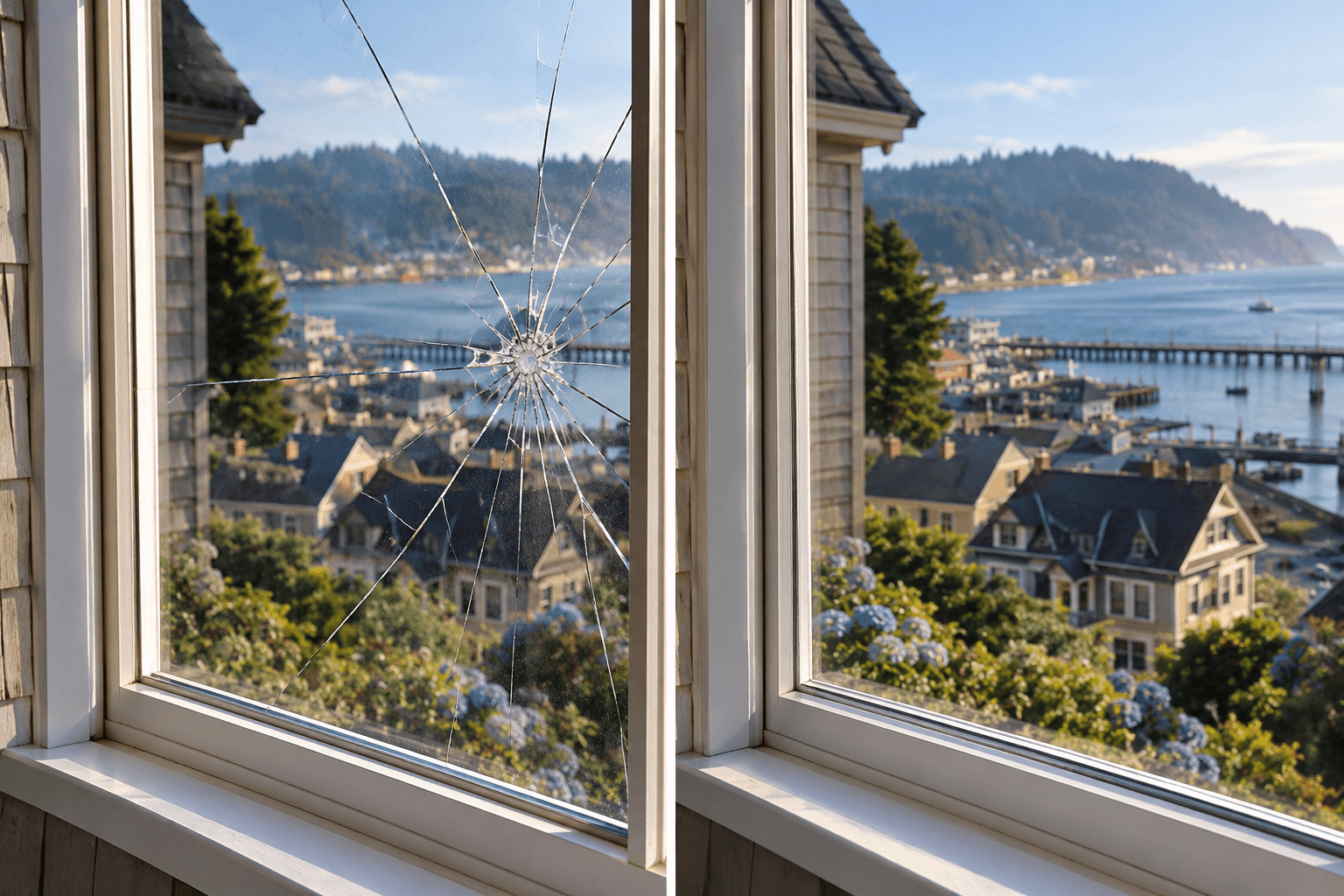
Every fall I get the same phone call. Somebody in Eureka shuffles into the living room with their morning coffee, the fog is just starting to burn off Humboldt Bay, and there it is: a crack running across the picture window that was definitely not there last night. Nobody threw anything. The dog has an alibi. And the first question out of their mouth is always the same: “Matt, can a cracked window be repaired, or am I buying a whole new window?” I’m Matt Jaques, and I’ve been running Jaques of All Trades here in Eureka since 2008, so I’ve had this conversation in Old Town Victorians, Cutten ranch houses, and more than one downtown storefront with a crack creeping across the “OPEN” sign.
Here’s the short version. The cracked glass almost always has to be replaced, but the window usually doesn’t. That difference is the gap between a few-hundred-dollar fix and a several-thousand-dollar window project, and it’s exactly where our glass contracting services earn their keep. My crew and I swap the glass, check the frame, and leave your window working like it did before the crack showed up. Below are the five questions I hear most, the honest answers, and how we handle each one at Jaques of All Trades.
Can a Cracked Window Actually Be Repaired?
House glass is not your car windshield. Windshields are laminated, which is why a chip can be filled with resin at the auto shop. Most home windows are plain annealed or tempered glass, and once a crack runs through it, there’s nothing to glue back together. Glass doesn’t heal. Window manufacturers point out that stress cracks in particular can’t be patched, only replaced, because they keep spreading every time the temperature swings.
Yes, I’ve seen the internet tricks. Clear nail polish on a hairline crack is the home-improvement version of putting a Band-Aid on a broken arm. It makes you feel like you did something. The glass disagrees.
What can be repaired is everything around the glass. On most jobs we replace just the pane or the sealed double-pane unit and keep your existing frame, sash, and trim, as long as the frame is sound. In Humboldt County, “as long as the frame is sound” is doing a lot of heavy lifting. Old wood sashes have been breathing salty marine air for decades, so the first thing I do on every glass call is poke the sill with a screwdriver. If it’s solid, you get new glass. If the screwdriver sinks in like it’s testing a brownie, we talk about the wood too, and since we also do carpentry, that’s one visit instead of two contractors.
Why Did My Window Crack When Nothing Hit It?
Nine times out of ten, the culprit is thermal stress. Pella breaks window cracks into three causes: thermal stress from temperature changes, impact from something hitting the glass, and pressure changes inside insulated glass units. A stress crack has a signature look. It starts at the edge of the glass at roughly a right angle, then wanders off in a curve, with no impact point anywhere.
Thermal stress happens when one part of a pane is warmer than another, so the glass expands unevenly until something gives. These cracks show up most often on large panes that are partially shaded, and they’re commonly triggered by cold nights followed by fast morning warm-ups. If that sounds like a description of Eureka in October, that’s because it is. Chilly, foggy night, then the sun punches through around ten and lights up the bottom half of your picture window while the top half sits in the porch shadow. Older windows with standard annealed glass are more vulnerable than tempered or heat-strengthened glass, and Eureka has no shortage of older windows.
So it’s not your fault, and it’s probably not the neighbor kid. On the business side, I see the same thing on big storefront panes that bake under afternoon sun on the bottom and sit under awning shade on top. Same physics, bigger piece of glass.
How Long Can I Live With a Cracked Window?
Not as long as you’re hoping. Stress cracks often start at an inch or two and keep growing with each warm-cold cycle. A cracked pane leaks heat, lets rain find its way in, and makes the window easier to break into. With the rainy season rolling into Humboldt, a crack that’s a cosmetic annoyance in October can turn into a wet sill and stained drywall by December. (We fix drywall too, but I’d rather sell you the cheaper repair.)
If you need to buy a few days, run clear packing tape over the crack on both sides of the glass. Dry and warm the glass first, because cold weather weakens the adhesive. If the pane is fully broken, put on gloves and eye protection, clear the shards, and tape heavy plastic or plywood over the opening. Then call someone who replaces glass for a living.
For business owners, a cracked storefront is more urgent. Customers lean on glass, kids press their faces to it, and plywood over your front window tells everyone driving by that something went wrong. We bump those calls up the list because a business can’t run behind particleboard for a month.
How Much Does It Cost to Replace Cracked Window Glass?
Nationally, This Old House puts window glass replacement at an average of $375, with most jobs landing between $300 and $880 per window. Labor runs about $50 to $75 an hour for window pros, and large storefront panes can cost $500 to $3,000 to replace, with tempered glass running as high as $25 per square foot, according to Bob Vila’s window glass cost guide.
Here’s what actually moves the price on jobs around here:
- Double-pane units are made to order to your exact size, so there’s a short wait while the glass is built.
- Low-E coatings and tempered glass cost more than plain clear glass.
- Old wood sashes with original glazing putty take more careful hands than a modern vinyl window.
- Access matters. A second-story Victorian bay window is a different afternoon than a ground-floor slider.
The biggest savings come from not replacing what still works. When you book professional glass replacement in Eureka with us, you get one honest quote that covers the glass, the sill, and the trim, instead of a window salesman quoting you an entire new unit because that’s the only thing he sells.
Do I Need a Permit to Replace Window Glass in California?
Usually, no. Under the California Residential Code, local building departments, including our neighbors in Shasta County, note that a permit isn’t required when only the glazing is replaced.
But skipping the permit doesn’t mean skipping the code. Glass in “hazardous locations,” like doors, panes next to doors, and windows near tubs, showers, and stairs, has to be safety glazing. Tempered glass is the usual choice, and you can spot it by the small etched mark in the corner. The classic DIY mistake is replacing a cracked pane next to a front door with ordinary glass from the hardware store, which turns a minor repair into a real injury risk. I covered this in detail in our guide on where safety glass is required, and it’s something we check on every job before we order glass.
Get the Crack Fixed Before the Rain Does
A cracked window rarely fixes itself, but it almost never means a whole new window either. Most of the time you need new glass, a solid frame, and someone who knows the difference. That’s what Jaques of All Trades does every week for homeowners, landlords, and business owners across Eureka and Humboldt County. Call or text the Jaques of All Trades glass contracting team at (707) 834-3933 or stop by 1609 Dean Street, and we’ll get your glass swapped before the next storm rolls off the Pacific. Your dog will be cleared of all charges.

Leave A Comment