I get this question more than you’d think: “Matt, is ‘facility maintenance’ just a fancy way of saying handyman with a bigger invoice?” Fair question. Half my clients picture a guy in a jumpsuit with a giant ring of mystery keys, wandering a building and occasionally tightening something. The other half picture an entire maintenance department they can’t afford. The truth sits right in the middle, and honestly, that’s where I like to live.
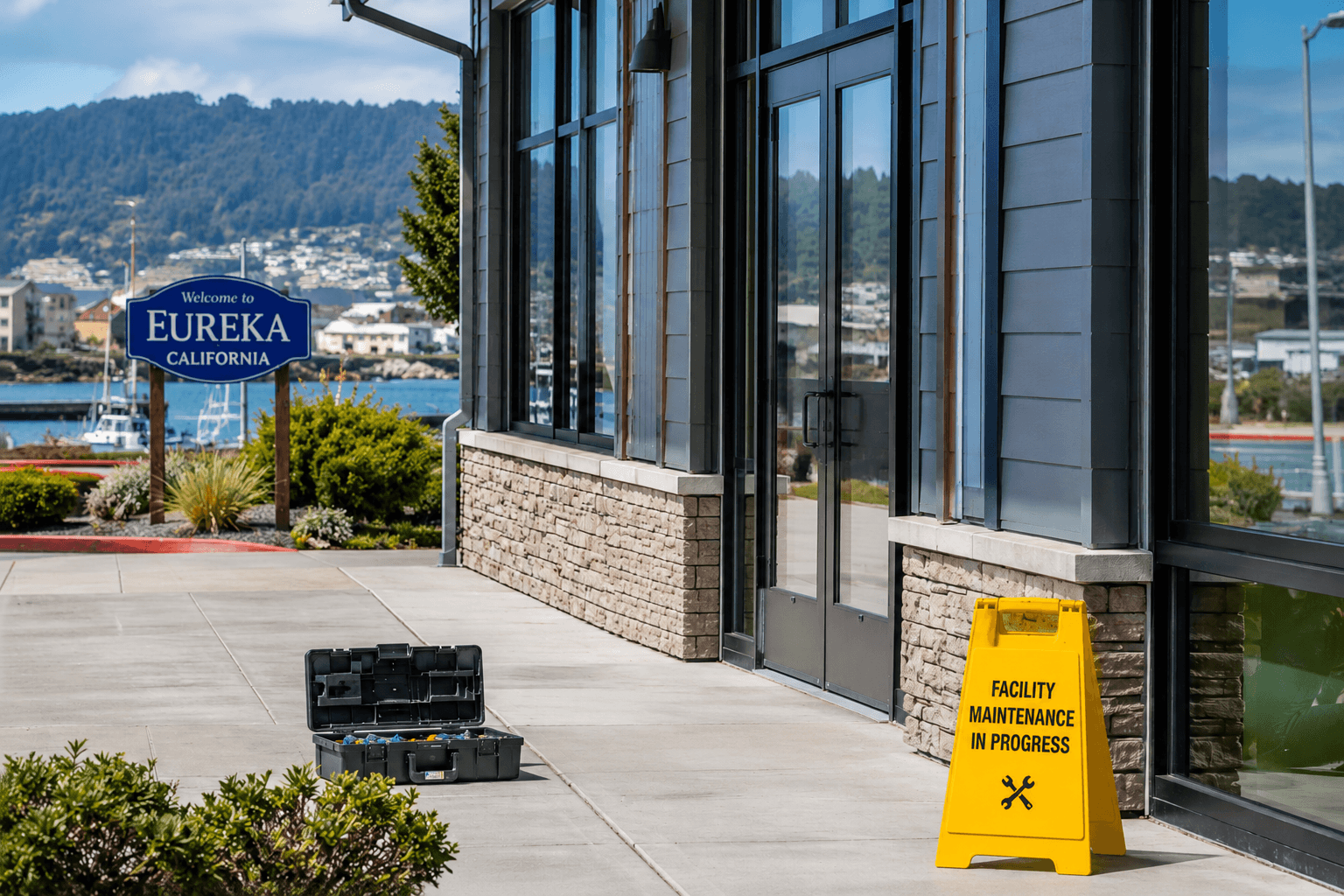
Here in Eureka, I’ve spent years patching walls, rewiring outlets, hanging cabinets, and generally making buildings behave the way they’re supposed to. Somewhere along the way, “can you fix this one thing” turned into “can you just handle the whole property,” and that’s really what facility maintenance comes down to. It’s not one job. It’s a whole rotating cast of little jobs that, if ignored, eventually become one very expensive job.
So What’s Actually Included?
If you own or manage a property — home, small office, rental, retail space, doesn’t matter — you’ve got systems running constantly whether you think about them or not. Plumbing. Electrical. HVAC. Doors that are supposed to close all the way. Paint that’s supposed to stay on the wall instead of peeling off like a bad sunburn. Every one of those systems needs somebody keeping an eye on it, and that somebody is usually me.
A typical week might have me swapping out a leaky faucet cartridge in the morning, running new electrical for a break room outlet after lunch, and finishing the day patching drywall where somebody’s office chair decided to become a battering ram. It’s not glamorous. It is, however, exactly the kind of work that keeps a property from quietly falling apart while nobody’s watching.
Why Preventative Beats Reactive (Every Single Time)
I’ll be blunt: reactive maintenance is expensive maintenance. Waiting until the water heater fails at 6 a.m. on a Saturday, or until the exterior trim rots because nobody caught the leak two years ago, is how a $150 fix turns into a $3,000 project. I’d rather walk your property twice a year, catch the loose gutter bracket and the cracked caulk line before they become somebody’s emergency, and save you the heart attack later.
That’s the whole philosophy behind good facility maintenance — you’re not paying someone to react, you’re paying someone to notice. A squeaky door hinge today is a sagging door tomorrow. A slow drain today is a burst pipe under your kitchen sink next winter. I’ve been doing this long enough to know which small problems are actually small, and which ones are wearing a small problem’s clothes.
Emergencies Still Happen — And That’s Fine
Now, prevention isn’t magic. Things still break at the worst possible time, because that’s apparently a law of physics specific to homeownership. A pipe bursts. A breaker trips and won’t reset. A door blows off its hinges in a coastal windstorm (very on-brand for Humboldt County weather). When that happens, you don’t need a lecture on preventative maintenance — you need somebody who picks up the phone and shows up with the right tools already in the truck.
That’s the other half of the job: being the guy who’s actually reachable when things go sideways, instead of the company that puts you on hold for forty-five minutes while a hold-music saxophone ruins your afternoon.
Every Property Is Different, So Every Plan Should Be Too
I’ve worked on properties where the punch list was basically “keep the lights on and the doors closing,” and I’ve worked on ones where the owner wanted a full seasonal walkthrough with a written report. Neither approach is wrong. What is wrong is treating a 1920s bungalow with original wiring the same way you’d treat a five-year-old commercial building. Age, size, budget, and how hard the building gets used all change what a smart maintenance plan looks like.
Before I start any facility maintenance relationship with a client, I walk the property first. I want to see what’s already been patched, what’s original, what’s about to become a problem, and what’s simply cosmetic. Then we build a plan around that — not around a generic checklist some franchise handed me.
A Handyman Who Actually Covers the Whole List
One of the reasons clients stick with me instead of juggling four different contractors is that I genuinely cover the range: electrical, drywall, light carpentry, painting, fixture repair, HVAC servicing, glass and door work, furniture and fixture installs — the whole spread. You call one number instead of five, and I already know your building’s history instead of showing up cold every time. That continuity matters more than people expect. The guy who fixed your water heater last spring is going to notice something’s off with your electrical panel faster than a stranger will.
I’ll also say this: the broader handyman and facility trades have some genuinely useful standards behind them, even for a one-man operation like mine. Groups like the International Facility Management Association set the bar for how commercial properties should be maintained at scale, and organizations like BOMA International shape a lot of the best practices that trickle down into how any smart property owner thinks about upkeep — residential included. Even national names like Mr. Handyman, part of the Neighborly family of home service brands, have helped standardize what “professional handyman service” is supposed to look like, which honestly makes my job easier when I’m explaining to a new client why routine maintenance is worth the investment.
What Property Owners Get Wrong
The biggest mistake I see isn’t neglect — most people genuinely care about their property. It’s timing. Folks wait for something to look bad before they call, when the smarter move is calling when it still looks fine but is starting to sound or feel a little off. A door that’s begun sticking slightly in humid weather, a breaker that trips once and you assume was a fluke, a faucet handle that’s gotten a bit stiffer than it used to be — those are the moments to make the call, not six months later when the door won’t close at all or the breaker won’t reset at 11 p.m.
The second mistake is assuming maintenance has to mean a big contract or a big commitment. It doesn’t. Sometimes it’s a single seasonal walkthrough. Sometimes it’s a standing quarterly visit. Sometimes it’s just knowing you’ve got a number saved in your phone for the day something finally gives out. All of those count, and all of those beat the alternative of hoping nothing breaks until you sell the place.
Bottom Line
If your building’s system of small annoyances is starting to add up — a drawer that won’t stay closed, a light that flickers when the wind blows, paint that’s given up on life — that’s usually the early warning system for facility maintenance you actually need. Better to call now, while it’s still an easy fix, than later, when it’s a story you tell contractors while wincing.
I’ve been doing this work in Eureka and Humboldt County long enough to know that the properties that get the least dramatic phone calls are the ones that get looked at regularly. So if it’s been a while since anyone walked your commercial property with a critical eye, let’s fix that — starting with the parts that are actually broken, and moving on to everything that’s about to be.
Give me a call, send a text, or reach out through the site. I’ll come take a look, tell you the truth about what needs attention now versus what can wait, and we’ll go from there.

Leave A Comment